
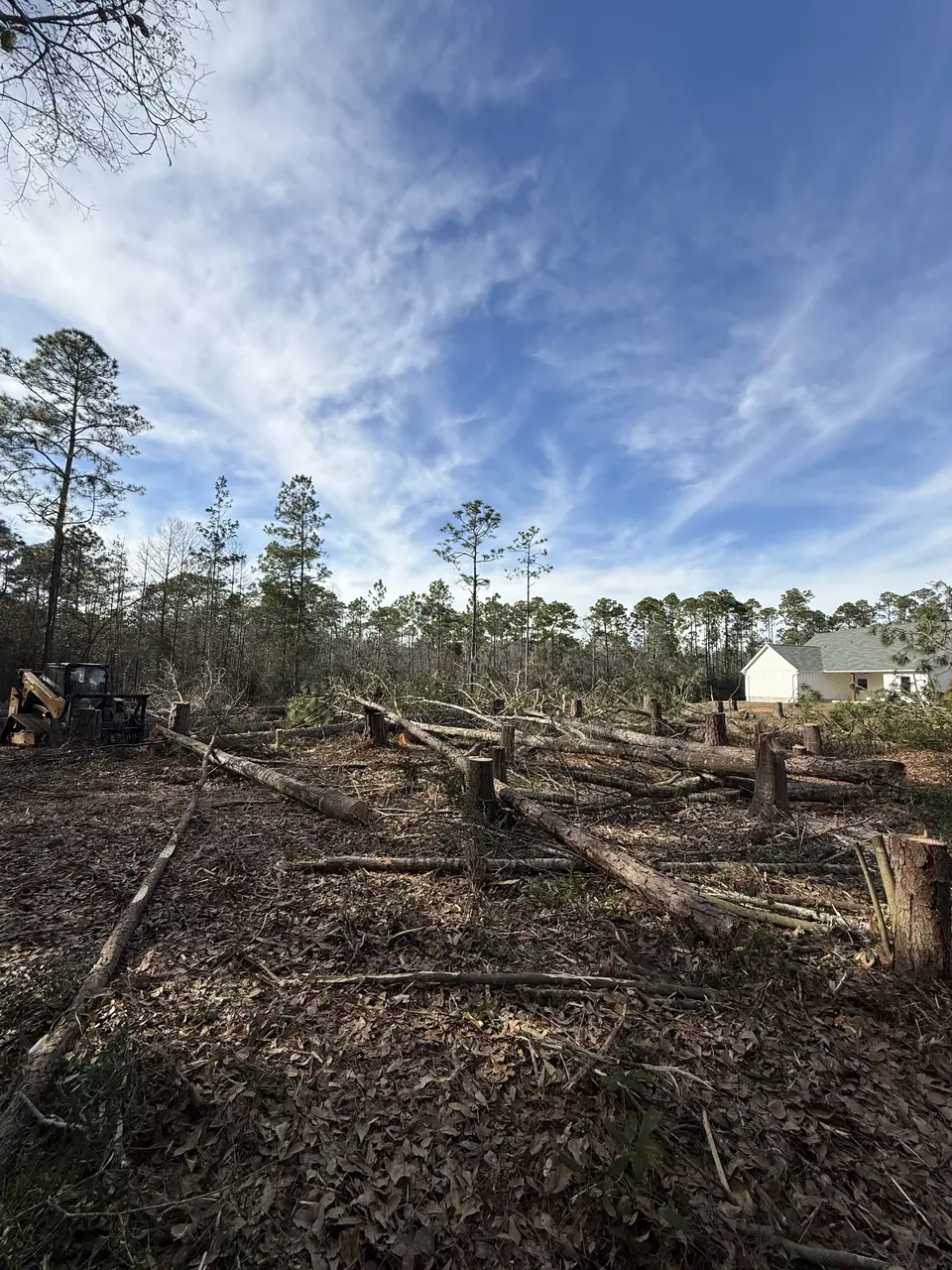
Storm debris cleanup in Northwest Florida: who picks up what, what it costs and who pays
After a declared storm, the county collects separated storm debris from the public right of way. Getting that debris to the road is the property owner’s job. Anything still on private ground stays a private cost. Published cost guides put fallen tree removal at $250 to $3,000, with most jobs near $750 to $1,200.
Pines take the worst of it. They are shallow-rooted in sandy soil, and hurricane season runs June through November. Our storm cleanup with grapple equipment opens the driveway first, then works trees off fences and outbuildings. Clearview is a land-clearing company, and the work is done from the machine.
What do Escambia, Santa Rosa and Okaloosa County pick up after a storm?
Each county decides after the storm whether special debris collection runs. Escambia County, the city of Pensacola and the town of Century decide whether a storm warrants special debris collection. Santa Rosa County, Gulf Breeze, Milton and Jay make the same call on their side. Once collection is on, debris has to be sorted into set piles and set on the right of way.
| Pile | What goes in it | What does not |
|---|---|---|
| Vegetative | Tree limbs, leaves, logs, pallets and tree branches | Fencing and construction materials |
| Construction and demolition | Furniture, carpet, tile, steel, glass, brick, concrete | Anything vegetative |
| White goods | Washers, dryers, refrigerators, ranges, microwaves, water heaters | TVs and other electronics |
| Electronics | TVs, computers, monitors, fax machines, stereos, speakers | Appliances |
| Household hazardous waste | Cleaning supplies, batteries, lawn chemicals, oils and pesticides | Anything from the other four piles |
Pickup is not open-ended. The City of Pensacola warns that special collection may be available only for a limited time. After that window, debris will be the responsibility of the property owner. More detail sits on our page for hurricane cleanup in Pensacola and Escambia County.
Santa Rosa County wants all yard waste placed on the right of way. On a normal week, limbs must be less than four feet long, 12 inches across or 60 pounds. Larger tree sections may be collected as expanded service after a declared disaster.
In unincorporated Escambia County, ECUA takes up to 20 yard waste bags a week. Cut limbs should not exceed six feet in length or 40 pounds. They go in two piles of no more than 6 feet on a side, set within two feet of the curb. Inside the city, Pensacola collects limbs that do not exceed 6 feet in length.
Okaloosa County has no single countywide rule. Residents need to check with their city or their hauler. On a private road, you need to plan ahead for your own disposal.
Will the county pick up debris a contractor cuts on my property?
Okaloosa County answers plainly: contractors are responsible for debris removal, and that is included in their fees. Public crews work the road, and the county’s debris plan says no equipment shall be allowed behind the curb. Debris still sitting on private ground is a private cost.
Okaloosa County’s debris plan counts debris from private property once it sits at the curb of a public or private right of way, and only where removing it is legally the county’s job. Ask the county before you assume a pass covers your road.
FEMA pays for debris work that is eligible under Public Assistance Category A, which turns on whether the removal is in the public interest. Removal of debris from commercial property is generally ineligible. So is debris from vacant lots, forests, heavily wooded areas and unimproved property. Commercial waste should not be placed on the right of way in Escambia County.
What does storm cleanup cost?
Published cost guides put tree removal at $250 to $3,000, with most homeowners paying $750 to $1,200. This Old House lands inside that band at $820 to $992. Size moves the number most: trees under 30 feet run $150 to $450, and trees over 80 feet reach $1,000 to $2,000.
The guides split on a tree that is already down. Today’s Homeowner prices already fallen trees at $100 to $500, well under any standing removal. Lawn Love puts a 30-foot tree at $285 to $435.
Storm timing adds to it. Urgent removals can cost $500 to $3,000 more, and emergency removal can reach $5,000. Hauling gets priced by the load, and one 2026 guide puts most junk removal jobs at $50 to $361.
Stumps are quoted on their own. Published guides put stump grinding at $150 to $400, cheaper than digging a stump out. Getting stumps ground below grade is a separate line item.
Does homeowners insurance pay for fallen tree cleanup?
Florida’s Department of Financial Services says most policies cover debris and tree removal if the downed tree damaged insured property, regardless of who owned the tree. There are usually limits on what the company will pay. If the tree hit nothing, there is usually no debris removal coverage at all.
The Insurance Information Institute puts it the same way. If a tree hits your home or other insured structure, the standard policy covers damage to the structure and its contents. Policies do not pay for the removal of trees or landscaping debris that did not cause damage to an insured structure.
Some policies pay when the downed tree blocks the main entrance to the property. Trees, plants and shrubs are also covered under standard homeowners insurance, generally for about $500 per item, and not for disease or poor upkeep. Check your policy.
Who is responsible when a neighbor’s tree falls on my property?
Florida’s answer surprises people. The UF/IFAS Handbook of Florida Fence and Property Law says that if a live tree falls onto the adjoining property, then the adjoining landowner is responsible for any damages. A healthy tree that blows over in a storm does not put the fault next door. Ask a lawyer before you push a real dispute.
Branches and roots follow the same line. If the branches or roots are healthy, then the landowner with the tree is not liable for the damage they cause. A neighbor may trim back the branches or roots as he or she desires, up to the property line, at his or her own expense.
Dead wood flips it. If the branches are dead, however, then the landowner with the tree may be responsible for the damage.
On the insurance side, the route is your own carrier. The Insurance Information Institute says you need to file a claim with your insurance company when a neighbor’s tree hits your house. Your insurer may then go after the neighbor’s policy if the tree was diseased. Check your policy.
Can I burn storm debris in Florida?
Sometimes, and downed trees follow stricter rules than leaves. Florida DEP files trees, tree stumps, and tree limbs as residential tree cutting debris. That burn must be set back at least 300 feet from any occupied building other than the landowner’s. Add 100 feet from any paved public roadway, and 50 feet from any wildlands, brush or combustible structure.
Yard waste is the easier category. Leaves, brush and palm fronds burn in a pile no greater than eight feet in diameter. The setbacks drop to 150 feet from any occupied building other than that of the landowner, 50 feet from any paved public roadway, and 25 feet from any wildlands, brush, or combustible structure.
Piles greater than 8 feet in diameter require a burn authorization from the Florida Forest Service, and land clearing needs one too. Non-residential land clearing pushes the setback to at least 1000 feet from any occupied building.
Timing is fixed. The fire must be ignited after 8 a.m. CT and put out one hour before sunset. The debris must have been generated on the same premises as where it is burned.
Some material never goes on a pile. Burning household garbage is illegal, and Rule 62-256 bars asphalt, roofing material, tar, treated wood, plastics, garbage, or trash.
One more line matters after a hurricane. The Florida Forest Service tells property owners to refrain from burning immediately following a storm and seek alternative removal methods. Ask the county.
In what order should a storm-damaged property get cleaned up?
Access first, then structures, then the rest of the property. A blocked driveway is the emergency, so the way in gets opened before anything else. Trees on fences, sheds and outbuildings come next, and the open ground waits. Working in that order keeps the property usable while the slower work gets done.
Leaners and hangers change the order. OSHA defines a lodged tree as a tree that has not fallen completely to the ground because it is lodged or leaning against another tree. Do not work in the presence of lodged trees, it says. Have them pushed or pulled down by a machine.
A hanger is a broken limb left overhead, and OSHA says to knock those down by machine. UF/IFAS says all leaning trees should have their roots carefully examined for breakage, and that storm damage cleanup is extremely dangerous, even for professionals.
If a leaner is aimed at a person, building, power line or roadway, it should be removed immediately after the storm. A leaner comes down with the grapple, never with a ladder and chainsaw.
The debris then has three ways to go. Brush and tops get mulched in place with the forestry mulcher. Trunks and heavy limbs get staged at the road where the county runs storm collection. What is left gets consolidated on site.
Root balls and torn earth come out with the mini excavator, and regrading torn ground and root-ball craters closes the holes. Fence lines get freed as the clearing moves, so fence lines rebuilt after storm damage runs on the same pass.
Clearview clears downed trees and storm debris across Santa Rosa, Escambia and Okaloosa Counties with grapple equipment. After a storm the crew works its list in order, with access emergencies first. The on-site estimate is free, with a written number. Call (850) 910-2447 for a free estimate after the storm.